Events
The latest events at the Berkeley Risk and Security Lab
Upcoming Events
Enemies in Agreement: Political Volatility and the Design of Arms Control
Amidst ongoing international competition, arms control remains rare despite potential mutual benefits, and agreements vary dramatically in their approaches to monitoring. In this talk, Jane Vaynman will discuss her book, Enemies in Agreement: Political Volatility and the Design of Arms Control, revealing how uncertainty from domestic political changes — such as leadership transitions or social unrest — can enable arms control.
Jane Vaynman
A Day in the Life at the U.S. Department of State
Cal students interested in careers at the State Department are encouraged to attend this talk by Brad Potter who will share reflections from his years at the U.S. Department of State, including in the Bureau for European and Eurasian Affairs, Bureau of Arms Control and Nonproliferation, and Policy Planning Staff. Brad has also served in the U.S. Department of Defense in the Office of the Undersecretary of Defense for Policy, Office of Strategy, Plans, and Capabilities.
Dr. A. Bradley Potter
Cheyenne Tretter: Private Arms, Public Consequences: Rethinking Arms Competition and War in the Age of U.S. Defense Industry Privatization
The post-Cold War transformation of the U.S. defense industry has fundamentally altered the dynamics of global arms competition and the connection between arms racing and the risk of war. This talk will cover how increasing levels of privatization have transformed U.S. arms production and whether it also increases the likelihood of war initiation.
Cheyenne Tretter, Dr. Cameron Tracy
Dylan Spaulding: The US Nuclear Paradigm Shift: Pit Production, Nuclear Testing, and the fate of Stockpile Stewardship
The US nuclear weapons complex is undergoing its biggest transformation since the end of the Cold War. Increasingly sophisticated experimental, computational, and manufacturing techniques that emerged to support a strategy of science-based stockpile stewardship are now being applied as tools for vertical proliferation as emphasis shifts from ‘stewardship’ to production. The evolution of laboratory tools for weapons development comes with both challenges and opportunities for verification, nonproliferation, and disarmament. This talk will address the paradigm shift underway in the US and its implications for new plutonium pit production and the potential resumption of nuclear testing.
Dylan Spaulding, Dr. Cameron Tracy
Past Events
Argyris Kriezis: The Invisible Threat: GNSS Jamming and Spoofing in Today’s World
This talk will examine the rise of GNSS jamming and spoofing as a result of conflicts in Ukraine, Israel, and the Middle East, and its growing threat to civilian and military infrastructure worldwide. Drawing on research from the Stanford GPS Lab and collaborating universities, the seminar will show how interference intended for military targets often disrupts civilian systems hundreds of kilometers from active conflict zones. The speaker will cover methods for detecting, characterizing, and geolocating interference sources, and how early-warning technologies can help authorities respond before critical navigation and timing infrastructure is compromised.
Argyris Kriezis, Dr. Cameron Tracy
AI-Enhanced Intelligence, Surveillance, and Reconnaissance and U.S.-China Strategic Stability
Join BRSL and CSR for a webinar on how AI capabilities for space-based remote sensing are reshaping U.S.-China strategic stability and the implications of these dynamics for U.S. policy.
Garrett Hinck, Ted Fujimoto, Mike Albertson
AI-Enhancement of ASW Platforms and Risks to SSBN Survivability
Panel discussion of a new report that evaluates how different categories of AI enhancements could increase anti-submarine warfare platforms’ ability to detect ballistic missile submarines at varying depths, and assesses the potential implications for strategic stability.
Dr. Lindsay Rand, Eliana Johns, Barret Schlegelmilch, Eli Sanchez
Re-imagining International Law’s Prohibition on the Use of Force
Join the Berkeley Risk and Security Lab for a research seminar examining the possible demise of international law’s prohibition of force and attempting to chart a path forward.
Bailey Ulbricht
Atomic Backfires: When Nuclear Policies Fail
Dr. Ariel Petrovics will present her recent edited volume on how efforts to reduce nuclear weapons dangers may sometimes wind up exacerbating them. These efforts are considered fundamental to reducing the likelihood of nuclear catastrophe. Yet, no tool is guaranteed to succeed and some may even have unanticipated, counterproductive consequences for international security. In a field fixated on finding solutions, this book instead warns readers not to lose sight of the drivers and often calamitous effects of failed nuclear policies.
Dr. Ariel Petrovics
Modeling Hypersonic Missile Flight
This webinar will walk through the purpose, capabilities, and use of the Hypersonic Glide Vehicle Simulator, a recently launched web application that enables quick and easy modeling of the flight performance of hypersonic missiles. In addition to covering detailed use cases for this tool, it will walk through BRSL’s broader work on the integration of technical analysis into global security analysis.
Dr. Cameron Tracy, Dr. David Wright, Justin Ly

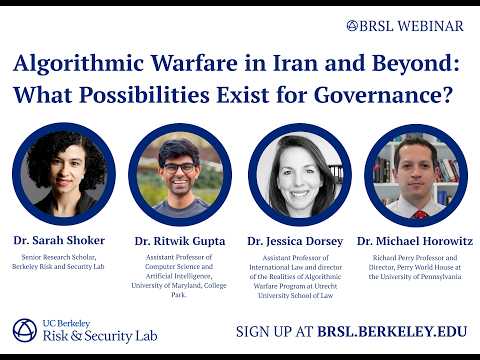
Algorithmic Warfare in Iran and Beyond: What Possibilities Exist for Governance?
The U.S. War on Iran has drawn widespread attention to the influence of AI and data science tools on military choices previously left to human judgement. At issue is whether the use of AI in military decision-making increases the risk to civilian life and if these tools accelerate the pace of war beyond the possibility of human oversight. Possible safety solutions, like improving the technical and regulatory guardrails over these systems, are meeting resistance in the United States and around the world. In the face of these challenges, how should technology, policy, and legal communities respond?
Dr. Sarah Shoker, Dr. Jessica Dorsey, Dr. Ritwik Gupta, Dr. Michael Horowitz
From Crust to Core: Analyzing North Korea’s Fissile Material and Strategic Resource Production
Sulgiye Park will discuss her research on North Korea’s production of critical materials for its nuclear weapons program. Combining satellite imagery, geological analysis, and technical assessment, she provides new, open-source intelligence on North Korea’s fissile material and nuclear weapons production capabilities. Her findings contribute to improved forecasting of future nuclear risks.
Dr. Sulgiye Park
Transpacific Collaboration Forum: Japan’s Partnering Strategy to Revitalize Its Semiconductor Industry
Forum speaker event. Keynote: “From System to Silicon: Japan’s Semiconductor and Economic Security Policy”
Kazumi Nishikawa, Yasu Ota

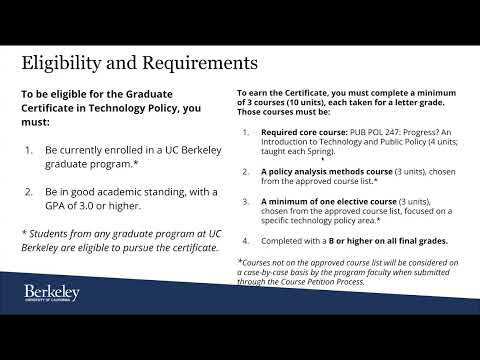
Fall Information Session: Graduate Certificate in Technology Policy
Join BRSL leadership for an overview of the Graduate Certificate in Technology Policy, including curriculum, application process, and career outcomes.